
A Classroom with a View
Over the summer, Mavericks have been traveling around the world during Education Abroad.
- published: 2026/08/12
- contact: Jared Craig, Social Media and Digital Engagement Manager - UNO Office of Strategic Marketing and Communications
- email: unonews@unomaha.edu
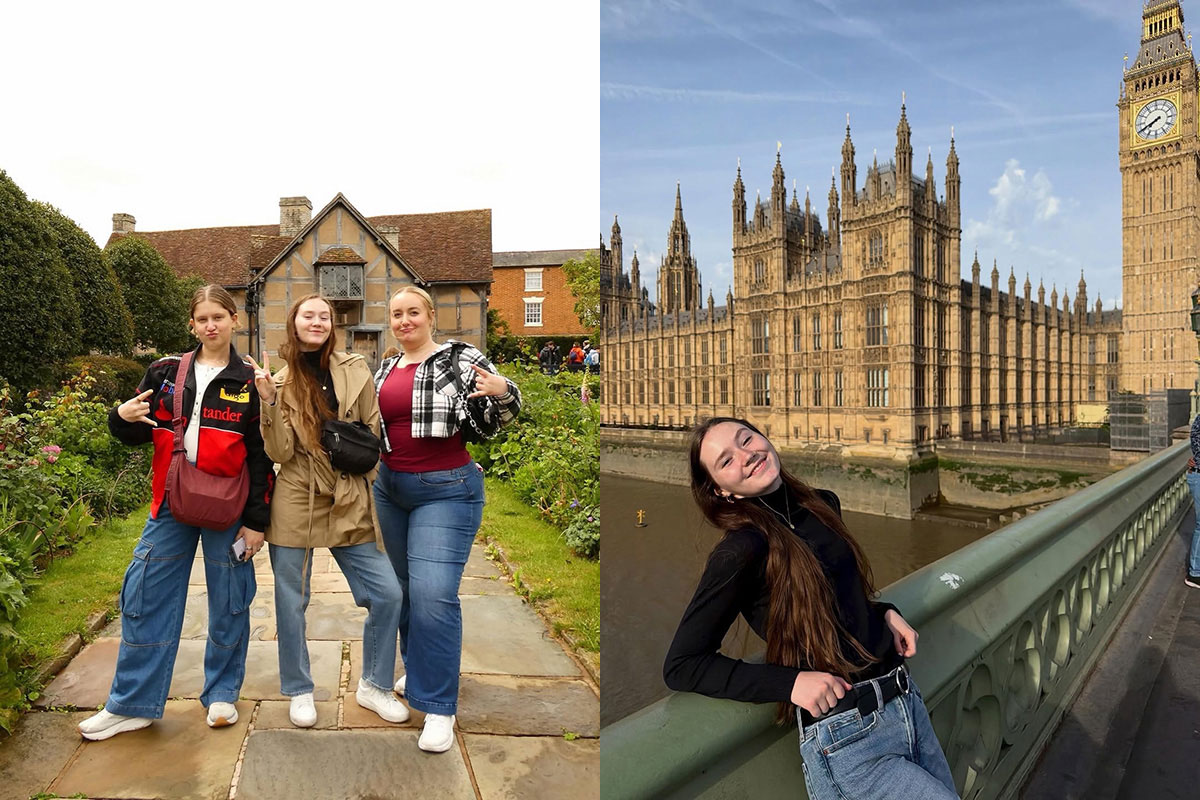
Camryn Busenbark traveled to the UK as part of a comparative study on the US and UK law enforcement systems. Photos submitted by Camryn Busenbark.
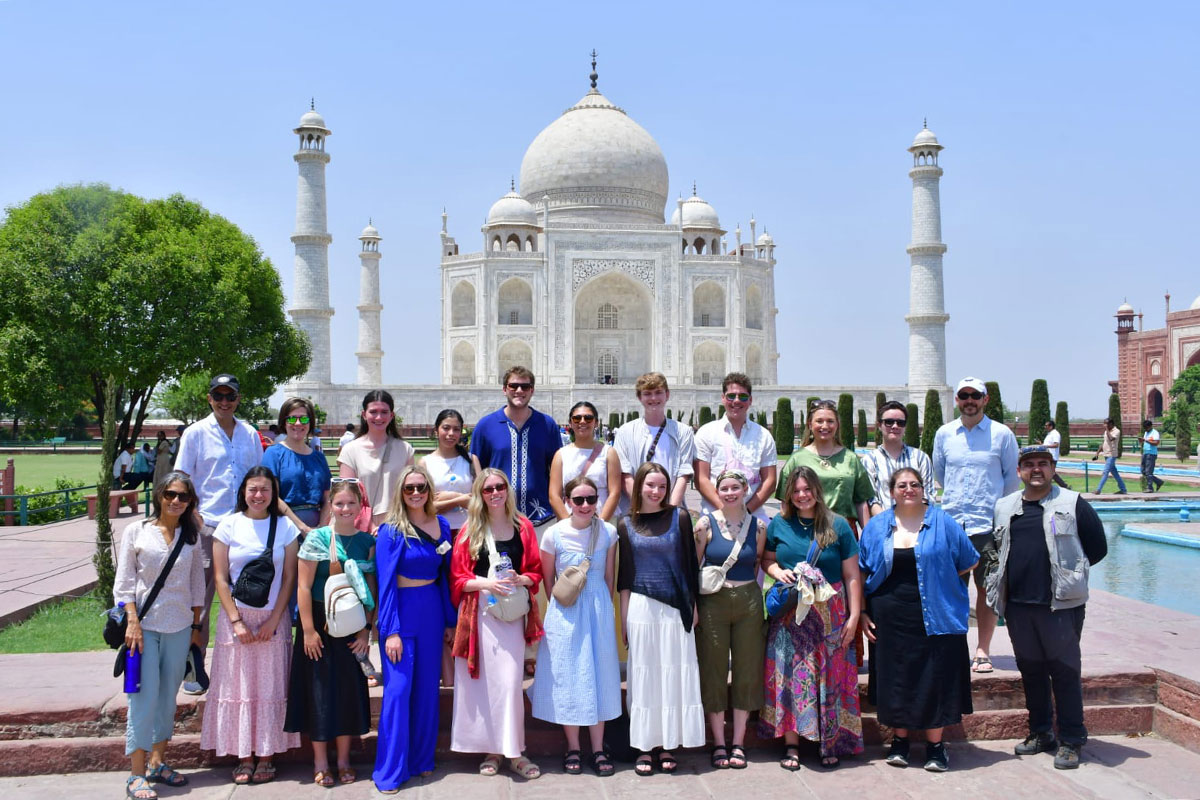
The Teacher Scholars Academy traveled to India to tour the country and volunteered as English-language tutors for a school. Photo submitted by the Teacher Scholars Academy.
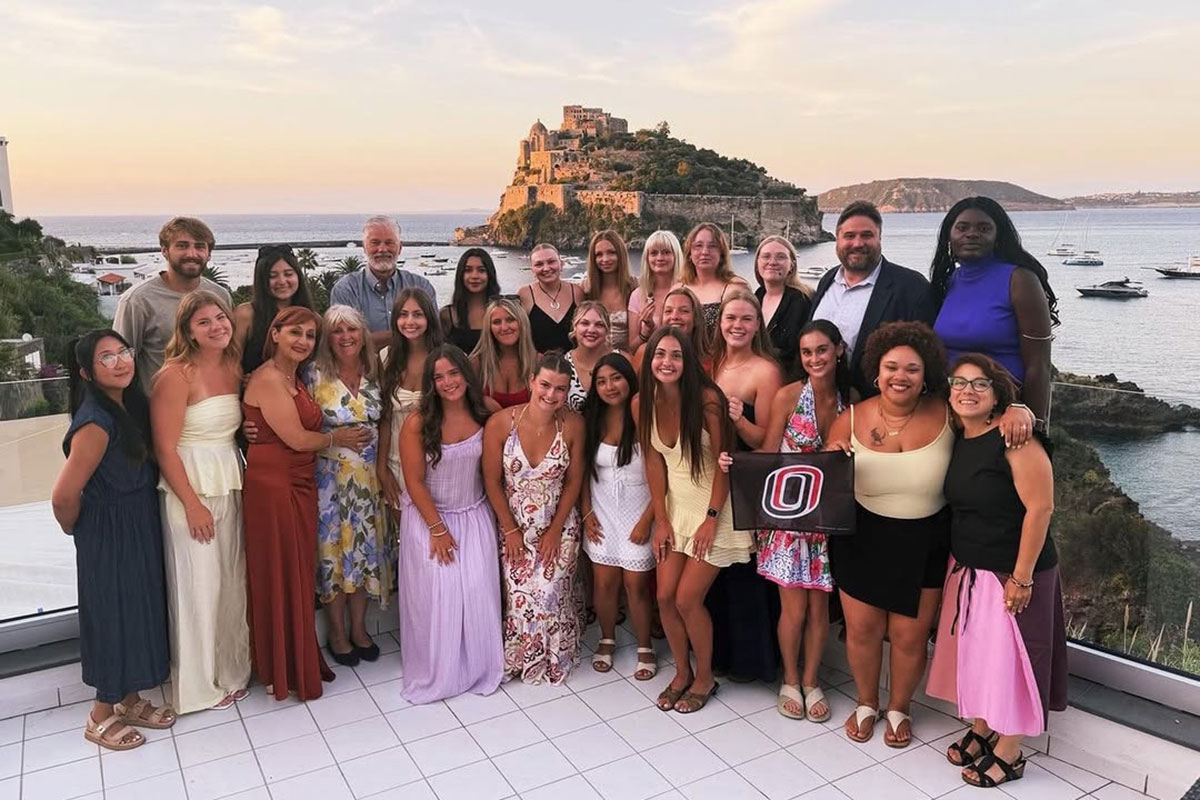
Psychology students toured Italy for a Education Abroad experience. Photo submitted by Caelah Brown
The village of Purkal is settled in the foothills of the gigantic Himalayan mountains in the most northern region of India. It’s home to the Purkal Youth Development Society, an organization that educates youth of disadvantaged backgrounds, including families without money to enroll their kids in schools as well as children living on the streets.
On this summer day, the children welcomed visiting students from the University of Nebraska at Omaha (UNO) and its Teacher Scholars Academy, who were there to teach conversational English. And for Teagan Sullivan, a junior secondary education and English double major, she wanted to give them an experience they would never forget.
She made a quick first impression. In a music class, she picked up a guitar and began playing “Horse With No Name” by America and “Kiss Me” by Sixpence None the Richer. In return, her students played the guitar and taught her Indian pentatonic scales. Later in a kindergarten class, she blitzed through communication barriers by drawing a zoo of animals on the whiteboard.
“I sat with these kindergarteners for an hour and a half, and they stuck to me the whole time,” she said, laughing. “They thought I was the coolest person ever.”
There was a workshop where UNO students taught children the macarena and square dancing.
“One of the teenage girls bonded with me because we both have tattoos,” Sullivan said. “She told me, ‘Oh my gosh, we’re like the same.’ And by the end of the workshop, she had me doing gymnastics.”
Sullivan learned that there are commonalities everywhere you go.
“You start to realize kids are just kids,” she said. “No matter where you are, we’re all human beings. Even if we’re completely different culturally, we’re all just able to bond and become one.”
Mavericks Meet World
The fulfilling feeling of engaging with the community in a meaningful way was a throughline for UNO students traveling across the globe this summer during Education Abroad programs. Many students travel alone, taking part in exchange programs with international universities, taking courses, as well as exploring the culture where they are residing. While others travel in groups connected by a common major or class, all organized through the Education Abroad office.
Caelah Brown traveled to Italy after taking a Positive Psychology, Health and Wellbeing course in the spring, which that gave her the chance to study mental health while experiencing a culture where rest is woven into daily life. On the trip, she saw what she never imagined she would.
Brown, a psychology major on the mental health track with a minor in medical humanities, explored historic sites, toured a lemon garden and historical churches, took part in a cooking class, visited thermal parks, and even practiced yoga overlooking an island in the Mediterranean Sea.
Among the highlights, Brown pointed to visiting Pompeii, the ancient Roman city destroyed by the volcanic eruption of Mount Vesuvius. The group toured ruins with a guide who explained the city’s pedestrians once moved around on raised stone crosswalks, at that time an innovation to city planning, as well as seeing its long-deceased residents still encased in ash.
“To stand there and take it all in for a second as the guide explained what happened to the city and its people. It was powerful to see,” Brown said.
Of course, a tour of Italy is incomplete without food and can look completely different than what many would imagine.
“We went to a secret hideout, which was inside a cave behind a private home,” she described. “Bottomless plates of food and homemade wine came out, and the owner played guitar and handed out tambourines, encouraging us to sing and clap along. It was truly a family-style meal and a beautiful experience.”
Meanwhile on the Indian subcontinent, Sullivan pointed to seeing the Taj Mahal as a life-changing moment.
“Just seeing something that vast, and just so intricate, and there were just so many aspects of that building that you can’t read about in books,” she says.
One detail that stayed with her was the guide’s explanation of rose designs near the tomb that appeared to glow red when light shined through them.
“That was really eye-opening to me,” Sullivan said. “I nerded out a lot for that.”
While visiting a market in Ladakh near the end of the trip, Sullivan heard there would be dancing nearby. She expected monks, but instead found a group of Ladakhi women dancing in a circle to a mix of folk songs and more modern music. =
After watching for a while, she decided to join them.
“I ended up just joining this giant dance circle of all women,” she said. “I felt so connected to a culture I never thought I would ever have connections to.”
She said the women helped her learn the steps, even though she was “doing a really bad job.”
“I just wish everyone could experience something like this,” she said, “because I think it’s crucial to understanding human connection and how to interact outside of your comfort zone.”
Advancing Their Careers
Camryn Busenbark, a recent graduate from May, traveled to the United Kingdom with a group of criminal justice majors to study how its criminal justice system compares to the system in the United States. The group, who just finished the course comparing the systems, traveled to apply what they learned in the classroom.
“We learned about their policing and how it differs from here, their judicial side of things, so how their courts operate, as well as their prisons, jails, and pretty much the criminal justice system as a whole,” Busenbark said.
The trip brought those lessons to life. Her group toured Wormwood Scrubs Prison, an all-male prison in the suburbs of London, where Busenbark noticed what she described as a strong emphasis on education and job readiness.
“It almost looked like a school,” she said. “They put emphasis on math, business, and job readiness skills, so that when these people are released, they are more prepared for reentry in society.”
The group also visited the Old Bailey Criminal Court, a site that has housed legal proceedings in London since the 16th century. Seeing firsthand how its judicial system is rooted in tradition, where students sat in on part of a murder trial and saw judges and barristers adorned in traditional wigs and robes. In a separate magistrate proceeding, they learned how lay volunteers handled smaller, less serious cases — a tradition dating back to when nobles handed out rulings over residents in their counties, as a way to stay connected with their communities.
“That was wonderful to see what we learned in the classroom and how it actually applied,” she said.
Outside of scheduled visits, Busenbark saw London policing in action when officers stopped to check on an unhoused person, offering water and asking whether support was needed.
“That was really eye-opening, because we don’t really see that much here,” she says. “The officers there are based in community policing— walking around, talking to people, not spending the majority of their time in cars.”
For Brown, the most meaningful lesson came from watching the pace of everyday life.
“One of the best parts of being there was just watching everybody not rush,” she said. “People were sitting around on doorsteps and against the churches. Nobody cared where you sit and relax, just as long as during that time you’re relaxing.”
That slower rhythm connected directly to what Brown hopes to do as a future mental health professional. She also noticed the way movement, food, and environment shaped her own wellbeing.
“There was a clear difference in myself when I was home versus when I went,” she said. “I wasn’t inflamed. Nothing hurt when I was there. I was just walking all over the place, breathing in the fresh air, eating clean every single day.”
Ultimately, it changed her mindset on how she wants to lead sessions as a future therapist, by offering a model for how rest, health, and culture can work together.
“I feel like that’s a huge reason why so many people are stressed, and why so many people need therapy, because they’re constantly overloading their nervous systems with everything,” she said.
For other students, education abroad cemented career plans.
“Traveling to India confirmed that this is what I want to do,” said Sullivan. “I want to teach.”
About the University of Nebraska at Omaha
The University of Nebraska at Omaha (UNO) is Nebraska’s premier metropolitan university, committed to innovating for the public good, advancing social mobility, powering workforce development, and serving as a hub for community engagement. Nearly 15,000 Mavericks choose UNO for its hands-on education experiences, nationally ranked online and graduate programs, military-connected student support, and innovative approaches to supporting lifelong learning. UNO holds the Carnegie Research Activity “R2” designation, securing more than $40 million annually in external research funding and counts its faculty among the world’s most cited scholars. Sixteen Omaha Athletics programs compete in NCAA Division I as members of the Summit League and National Collegiate Hockey Conference (NCHC).
Follow UNO on Facebook, Twitter (X), Instagram, LinkedIn, and YouTube.